
Back

7 minutes
Baker tips
Optimizing Your Bake: Adjusting Deck Settings on the Simply Bread Oven
Alisha Fuller


The Simply Bread Oven is designed to give bakers full control over their baking environment, allowing for precise temperature adjustments across multiple decks. Understanding how to adjust deck settings effectively can help you fine-tune your bake for optimal crust development, crumb structure, and consistency. Whether baking high-hydration sourdough or enriched dough, mastering deck settings is key to achieving professional results.
Understanding Deck-Specific Temperature Adjustments
How the Decks Function
The Simply Bread Oven treats each deck as an independent baking environment, meaning adjustments can be made to fine-tune heat distribution. When you set the oven to a particular temperature, each deck individually aims for that setting. However, if one deck is baking too fast or slow, you can use the set point adjustments to balance heat distribution.
The Role of Heating Elements
Each deck has three heating elements above it, but there is also a fourth heating element below the bottom stone that requires separate control. This bottom heating element is crucial because it is sandwiched between the stone and the oven floor, causing heat to radiate back up and making the bottom stone naturally hotter. To prevent excessive heat buildup, the Bottom Stone % setting allows you to adjust how long this element runs relative to the others.
For example, if the Bottom Stone % is set to 75% (the factory setting), the bottom heating element will run only 75% of the time that the upper elements do, helping to balance the heat and prevent burning on the bottom of your loaves. Adjusting this percentage lets bakers fine-tune their bottom crust development without affecting the overall deck temperatures.
How Temperature Adjustments Work
For example, when you set the oven to 500°F, each deck is programmed to target that temperature. If you adjust Deck 1 to -8%, that means it will bake at 8% lower than the set temperature. In this case, Deck 1 will be aiming for 460°F (500°F - 8% of 500°F). Understanding this calculation helps bakers fine-tune their deck temperatures for consistent and predictable results. Conversely, if Deck 2 is adjusted to +5%, it will bake at 525°F (500°F + 5% of 500°F).
It’s important to note that the percentage adjustment is always relative to the set temperature. A deck adjusted to -8% will always bake at 8% lower than the given temperature, so if you lower the main oven setting, each deck’s adjusted temperature will shift accordingly. This is why small, incremental changes are best when fine-tuning your bake.
Balancing Heat Distribution
If the top deck is running too hot, reducing its set point ensures a more even bake. Similarly, if the bottom deck isn't generating enough heat, increasing its set point ensures a more balanced baking environment. Understanding how these adjustments impact your results will help maintain consistency across different dough types and bake loads.
How to Adjust Your Deck Settings
To adjust the deck settings, navigate to the oven settings menu. Each deck has independent controls for temperature and heating distribution. You can increase or decrease the heat to optimize your bake based on dough type and oven behavior. Please see detailed instructions here.
When and Why to Adjust Deck Settings
Deck setting adjustments can directly impact the baking performance of your oven. If one area of the oven is baking faster than another, heat adjustments can balance the bake. Lowering or raising deck temperatures can affect crust development, internal crumb structure, and oven spring.
Positive vs. Negative Adjustments: Why Choose One Over the Other?
- Lowering the deck temperature (-1% to -8%): Useful when loaves brown too quickly or the crust thickens excessively.
- Raising the deck temperature: (1% to 8%) Useful for achieving an overall darker, more caramelized bake.
Key Considerations Before Adjusting Deck Settings
- Ensure your dough fermentation is consistent. Improper fermentation can lead to issues that appear similar to heat distribution problems.
- Verify that your oven is properly loaded; a less-than-full oven can behave differently than full-capacity loads.
- Make sure your steam settings are optimized. Too much or too little steam can impact bake results significantly.
- Consider lowering the baking temperature, especially if you're accustomed to baking at lower temperatures in a home oven. The Simply Bread Oven allows for precise control, so adjusting temperatures downward can help achieve better results without compromising bake quality.
- If you prefer a darker bake, increasing the baking temperature can enhance crust caramelization and deepen color while still maintaining even baking results.
Pro Tips for Optimizing Deck Settings
- Adjust at the right time: It's best to make deck setting adjustments either before or after a full bake day. Changing settings between bakes can lead to overcompensation, resulting in uneven browning, inconsistent crust development or even further burning. Planning adjustments ahead helps maintain controlled, predictable results.
- Make small, incremental changes: Adjust by 1-3% at a time to observe effects gradually.
- Take notes: Track adjustments in bake logs for reference and consistency.
- Test different dough types: Different hydration levels and ingredient compositions will react uniquely to deck adjustments.
- Monitor final crust coloration and texture: Evaluate whether further tweaks are needed based on the result.
Still Having Trouble?
If you're still experiencing issues after adjusting your deck settings, feel free to text or call our support team for additional assistance. We’re here to help troubleshoot and ensure you get the best possible performance from your Simply Bread Oven.
Tech Support
+1 (844) 946-4050
support@simply-bread.co
Related stories

5 minutes
News
Hattie's Bread Box Bakery is on the Rise
Lauren Leone


10 minutes
News
Fig and Bean Bakery: Taking Gluten-free bread to new heights
Sam Stevens


2 minutes
News
Ensuring Safety and Quality: Simply Bread Ovens now shipping with NSF Certification
Simply Bread Co.


4
Recipes
Vegan Morning Buns Recipe
Lauren Leone / Lisa Allen

9
Baker tips
Branding Your Cottage Baking Business

5 minutes
Stories
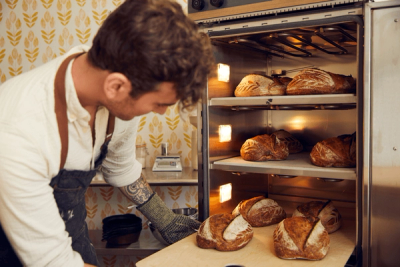
Simply Bread Oven – Compact Commercial Grade Oven for Small Food Businesses
Liana Gailand


5 minutes
Recipes
Sonora Blueberry Lemon Babka with Karen Quinones
Karen Quinones


3 minutes
Recipes
Dark Pan Loaves | Simply Bread Recipe
The Simply Bread Team